
The map
The world is a 600 × 600 grid shared by every player. Between the cities lie oases, forts, castles and the alliance shrines. Tap any tile to see what it is and what you can do there.



Oases
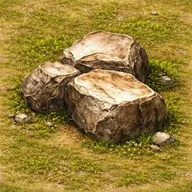
Wood, stone, iron and food oases run from level 1 to 10. Hold one and the city that captured it gets a flat hourly bonus of that resource. A held oasis loses one level every 48 hours, and the clock resets each time it is captured again. Catapults are the key to cracking oases, so build siege before you go after a high-level one.
Forts
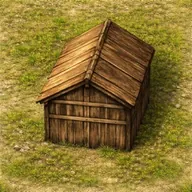
Forts pay hourly gold to your capital. They give no resources and never decay, and defeating one also loots a large one-time pile of resources. Their armies grow steeply with level, so scout before you attack. Only a Baron or higher can hold a fort.
Castles
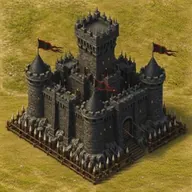
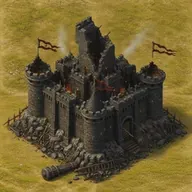
Castles, levels 1 to 5, are the hardest fights on the map: far stronger than a level 10 fort, with their own research and a wall of traps and turrets. Nobody can hold a castle. Win, and chests, keys and resource boxes land in your treasures at once. A beaten castle lies in ruins for two hours, then rebuilds.
Hunting
Hunting farms loot from an oasis you hold, or from any oasis nobody holds. Loot builds up while your party stays, and you choose when to cash it in: resources, equipment, chests and keys, title materials, cards, a few coins, and, rarely, scepters and crowns.
A map that changes
Every 12 hours the map spawns fresh oases and forts and removes the same number of unoccupied ones. New oases lean toward higher levels; forts come back at the level they replaced.
Cities and resources
You start with one city, 800 each of wood, stone, iron and food, 1,000 money and 100 population. Four resource buildings feed it: the Lumber Mill, Stone Mine, Iron Mine and Cropland, each with fields you upgrade one by one.
A city has eleven kinds of building:
- Main Building
- Lumber Mill
- Stone Mine
- Iron Mine
- Cropland
- Warehouse
- Cranny
- Barracks
- Market
- Tech Center
- City Wall
The warehouse sets how much you can store; the cranny hides a fixed amount of each resource from raiders. You can build two things at once, three with VIP.
More cities
Your title decides how many cities you may hold: a capital and up to six more, the first of them at Baron. Capitals can never be captured. Other cities can, once their loyalty has been worn down to zero.
Armies and generals
Four troop types train in the Barracks. These are their numbers in the game’s classic combat, which decides every battle:
| Troop | Attack | Defense | Life | Speed | Range | Carry |
|---|---|---|---|---|---|---|
| Infantry | 75 | 75 | 150 | 150 | 25 | 80 |
| Cavalry | 175 | 175 | 500 | 300 | 40 | 100 |
| Archers | 60 | 25 | 125 | 125 | 600 | 40 |
| Catapults | 300 | 100 | 450 | 50 | 800 | 40 |
Each city can also build up to 15 traps and 15 turrets to defend itself.
Your general
Every player has a general with four stats (attack, defense, speed and fortune), five skills (Unlock Chest, Hidden Attack, Heal, Break Cranny and Convince) and five equipment slots: sword, armor, horse, manual and ring.
Research
The Tech Center researches eleven technologies:
- Production: Woodcutting, Digging, Smelting, Planting
- Military: Attack Skill, Defense Skill, Shooting, Marching Skill
- Defense: Trap Research, Turret Research
- Scouting: Scout Skill
Battles
Battles are real time and you command them. The same rules apply to every fight: against players, forts, oases and held tiles.
- A battle opens, and the first round fires 30 seconds later. Every round after runs on the same 30-second clock.
- Each round you give every troop type an order (forward, wait or backward) and a target type.
- Forward closes on the enemy, ranged troops included. Wait holds position, which is how archers and catapults shoot from range.
- Catapults that fall back and give ground can’t be hit by melee that round, until they are pinned against the edge of the field.
- A battle lasts at most 20 rounds. If the defender still has anything standing after round 20, the defender wins.
The Barracks has a battle simulator for trying a fight before you send anyone. Scouting first helps too: each level of Scout Skill makes reports more exact.
Limits that protect players
- You can attack any one player at most five times a day (UTC), counting every attack on any of their cities.
- A city already under attack takes further attacks ten minutes apart.
- Attacks on oases and forts have neither limit.
- New players are protected for their first days. The current rule is on the starter guide.
Alliances
You can belong to one alliance at a time. Every alliance is approval-only and holds up to 50 members. Founding one costs 1,000 gold and needs a unique name and tag. New members join as Recruits until the leader or a vice leader promotes them.
Alliance war
Members pool resources in the alliance treasury and found an alliance city: a two-by-two city the whole alliance owns, with its own buildings, resource fields, army, research and wall, all paid from the treasury.
Across the map stands a fixed set of 41 structures: wood, stone, iron and food shrines, plus a Treasure Vault, Royal Mint, War Beacon and War Academy. Alliances capture them for bonuses and daily rewards.
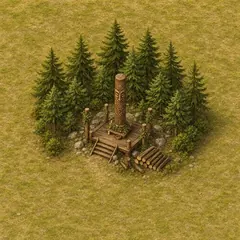

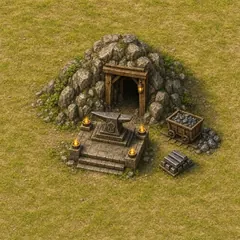
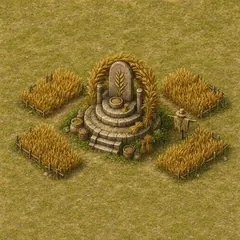
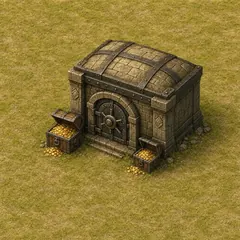
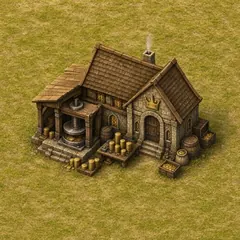
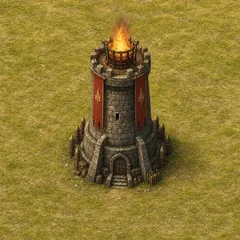
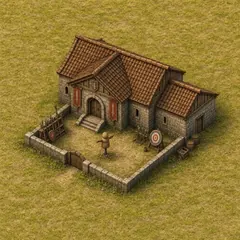
A leader or vice leader can declare war on another alliance. A war is a 48-hour contest between the two alliances’ cities, decided by the war score earned in assaults. Declaring costs nothing. There are no seasons: shrines, standings and alliance cities simply carry on.
Castles and Alliance Attacks
Attack a castle alone, or call an Alliance Attack: pick how long to gather (30 minutes, one, two or four hours), and members each send one army from any of their cities. The caller commands, and every player who qualifies gets the full castle reward.
- Members can start or join an Alliance Attack 24 hours after joining the alliance.
- Each player can be in one Alliance Attack at a time.
- Alliance war armies cannot attack castles.
Titles
Your title is your prestige rank. There are twenty: 3rd, 2nd and 1st Civilian, then the same three grades of Baron, Viscount, Earl, Marquis and Duke, then Prince Regent and King. Everyone starts as a 3rd Civilian.
Each title raises how many cities, forts and oases you may hold. Promotion past Civilian also takes title materials: nuggets, gemstones, medals, scepters and crowns.
Free to play
The game is free to download and play. Troops are trained, never sold, and equipment and title materials are not sold for coins: they come from hunts, chests, the Daily Spin and the player market.
Coins, the premium currency, are sold in packs. They buy VIP time, protection from attack (Refuse War), resource enhancement, and Treasure Shop items: chests, keys, speed-ups, resource packages and Enhancement Stones. VIP adds income and daily rewards; it does not make troops stronger or speed up building, training or research.
Ready for your first week?
The starter guide covers the first days step by step.